This is the last installment in my series of posts on Jesus’ disciples.
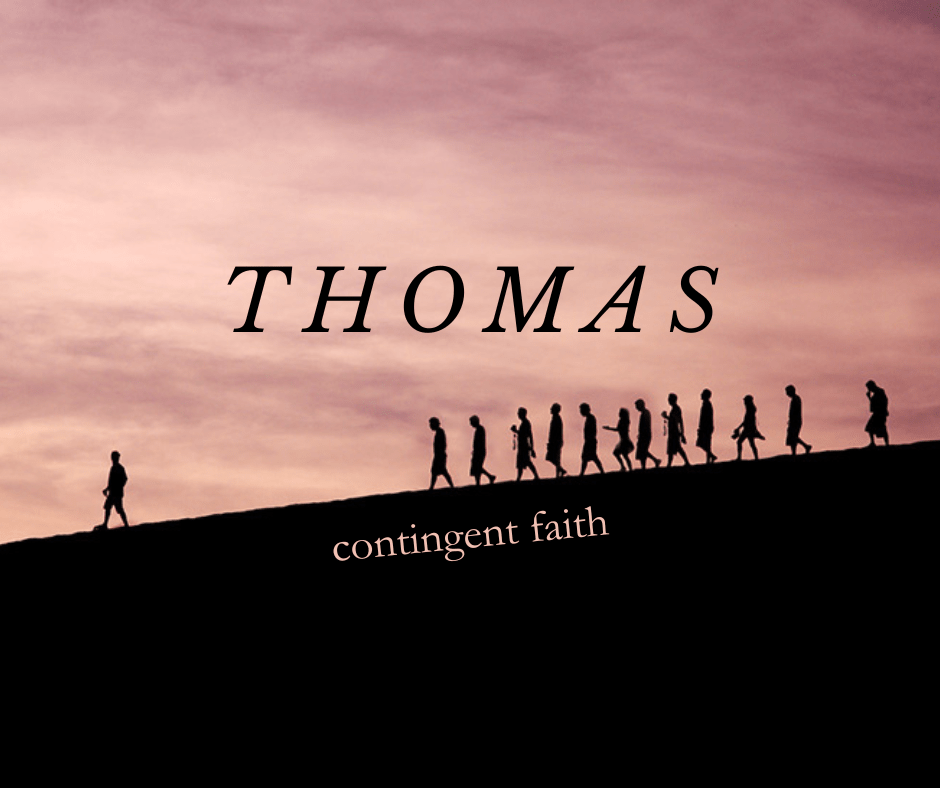
What does it take for you to believe God? What must He do for you to trust His word and have faith in His promises? We often call this disciple of Christ “Doubting Thomas”—but when I consider his actions, I wonder how many of us would have done the same. Many of us are probably familiar with the moment when Thomas refused to believe Jesus was alive “unless I see in His hands the imprint of the nails, and put my finger into the place of the nails, and put my hand into His side” (John 20:25). We might blame Thomas for his lack of belief. But when you think about it, the disciples were telling Thomas something that challenged the very laws of nature. Can we really be sure we wouldn’t have responded the same way?
Sometimes we make our faith contingent upon God proving Himself in some way. We tell Him, “if You will heal me, if You will fix my broken relationships, if You will answer my prayers the way I think you should…then I will believe You are good.” As Jesus hung dying on the cross, the crowd watching Him demonstrates this conditional belief. Matthew 27:39-42 says, “And those passing by were hurling abuse at Him, wagging their heads and saying, ‘You who are going to destroy the temple and rebuild it in three days, save Yourself! If You are the Son of God, come down from the cross.’ In the same way the chief priests also, along with the scribes and elders, were mocking Him and saying, ‘He saved others; He cannot save Himself. He is the King of Israel; let Him now come down from the cross, and we will believe in Him.’”
We must realize that faith which is contingent upon sight is not faith at all. As the author of Hebrews writes in Hebrews 11:1, “Now faith is the assurance of things hoped for, the conviction of things not seen” and later in verse 6, “And without faith it is impossible to please Him, for he who comes to God must believe that He is and that He is a rewarder of those who seek Him.” God wants us to have faith, and faith demands no receipt.
The hard part is that faith doesn’t just mean being willing to wait for God to fulfill our requests. It means determining to trust Him even if the answer is not what we expect. Think about Thomas’s statement. He didn’t refuse to believe Jesus was alive, but he made his belief dependent on Jesus doing what he wanted. In grace and goodness, Christ did appear to Thomas and gave him the assurance he wanted. But He didn’t have to—God is not under any obligation to prove Himself to us.
In John 14:5-6, we read, “Thomas said to Him, ‘Lord, we do not know where You are going, how do we know the way?’ Jesus said to him, ‘I am the way, and the truth, and the life; no one comes to the Father but through Me.’” It would seem Thomas was a man who wanted answers. He desired evidence and struggled to trust without proof. In response to this uncertainty, Jesus presents Himself as the one great, overarching answer—the one constant in a world full of unreliability. As C. S. Lewis wrote, “I know now, Lord, why you utter no answer. You are yourself the answer. Before your face questions die away. What other answer would suffice?” I believe we often grow discouraged because we are only looking for outcomes. In every situation, we wait around for God to give us the happy ending we want, while all the time, we are blind to His presence in our midst. Jesus didn’t say, “I can help you find the way, and the truth, and the life.” No, He said “I am.”
For the Christian, life isn’t a series of outcomes, some good and some bad. It is a journey with Christ that begins with belief in Him (a belief called blind by the world). In believing Him we learn to trust Him; in trusting Him we learn to follow Him; in following Him we become like Him. We are not complete until we enter His kingdom and see Him just as He is. Our faith will be made sight, our questions will become needless, and our souls will be at rest. But while we are still here, we must find our joy in knowing our God is good and is able to glorify Himself in everything. Whether God works the exact miracle we ask or we must humbly surrender our desires to His plan, He does not fail, He does not betray, and He does not forget us.
When Christ appeared to Thomas and he believed, Jesus said to him, “‘Because you have seen Me, have you believed? Blessed are they who did not see and yet believed’” (John 20:29). We are they who did not see. But if we’re not careful, we can fall back into Thomas’ disbelief, demanding that God show us a miracle before we trust Him. Don’t get be so focused on the miracle that hasn’t happened yet that you miss the miracles that are happening all around you: the hearts being changed, the relationships being restored, the steps being taken for Christ. “‘You need not fight in this battle; station yourselves, stand and see the salvation of the Lord on your behalf’” (2 Chronicles 20:17).
Get new posts delivered directly to your inbox!

 Steadfast, Immovable, Abounding
Leave a comment