The concept of freedom is one that permeates every element of our world. We talk of religious freedom, financial freedom, national freedom, individual freedom, moral freedom, social freedom, and for Americans, we speak of the freedoms described in our Bill of Rights. You might think that these conversations and the ideologies related to them would deepen the meaning of this word we all know. But I think the opposite is often true—the concept of freedom has become watered-down, obscured, and misunderstood through overuse.
So as we must to understand anything in this life, we turn to our one guaranteed source of truth. Yet even among those who derive truth from God’s word, there is still disagreement about how freedom plays out in the believer’s life. Romans 8:1-2 says, “Therefore there is now no condemnation for those who are in Christ Jesus. For the law of the Spirit of life in Christ Jesus has set you free from the law of sin and of death.” The Lord promises that Christ’s blood has freed us—we are no longer bound by the condemnation of sin. Yet Jesus also tells us in the Sermon on the Mount, “Do not think that I came to abolish the Law or the Prophets; I did not come to abolish but to fulfill. For truly I say to you, until heaven and earth pass away, not the smallest letter or stroke shall pass from the Law until all is accomplished” (Matthew 5:17-18). At first glance, these two concepts seem pretty contradictory.
If Christ has come to set us free from the bondage of the law, how is it that He still expects to follow His rules and is grieved when we do not?
Imagine for a moment a dog tied to a chain. The chain is quite long, and the dog has room to move about and access to every good thing it could ever need. As long as the dog stays well within the boundary defined by the chain, it doesn’t notice that the chain is even there. The boundaries do not seem restricting because it has no desire to wander outside of the designated space. But some inviting attraction catches the dog’s eye and it ventures to the edge. There the chain stops it short, and as the dog tugs persistently against its leash, the chain suddenly feels heavy, the collar painful, the boundary exhausting.
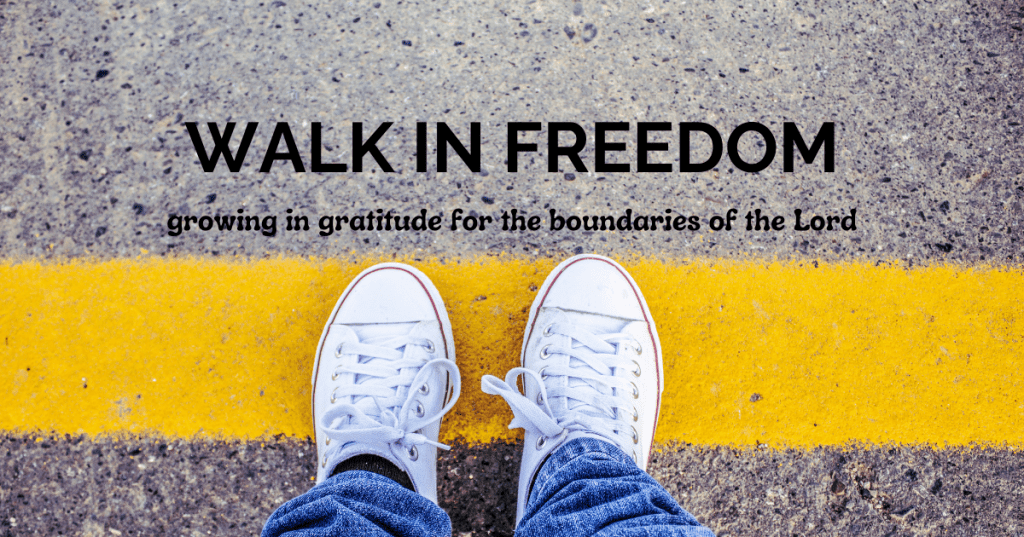
Such is the freed life of the believer. While we stay within the safe, healthy borders God has defined, we know what Christ meant when He said, “My yoke is easy and My burden is light” (Matthew 11:30). But when we take our eyes off Christ, our center, and allow the appeal of the world to catch our eye, suddenly the will of the Lord seems heavy, restrictive, and simply too hard to follow. We’re only burdened by the commandments of the Lord when we’re pushing the boundaries.
We are told in 1 Peter 2:16, “Act as free men, and do not use your freedom as a covering for evil, but use it as bondslaves of God.” Once again, we are presented with an apparent oxymoron—we are bondslaves who possess freedom. So if Jesus has not given us freedom to do as we wish, what exactly has He freed us from? Quite simply, He has freed us from the debt of paying for our sin through sacrifice, the penalty of eternity separated from the Father, the spirit of death that controlled our being, the sinful nature that left us vulnerable to Satan’s attacks, and the fruits of the flesh that waged war against us. Christ’s victory has not removed God’s requirement for holiness—a requirement which is perfectly fulfilled in Christ and will be completed in us when we stand in His presence. Hebrews 12:10 says, “He disciplines us for our good, so that we may share His holiness.” Christ’s victory (and vicariously, our victory) has set us free from sin—so why would we expect that His victory gives us the right to sin?
When I think of the Law, I think of the Israelites. Doubtless they didn’t understand why God put such strict guidelines on their behavior through the Mosaic Law. But as I look back on some of these commandments now, they make a whole lot of sense. The people were told not to eat blood (Leviticus 3:17), to quarantine lepers (Leviticus 13:46), to wash clothes after touching a dead animal (Leviticus 11:25), and of course, to never murder, steal, lie, or covet (Exodus 20). We don’t know how much the people understood the practical reason behind many of these laws, but chances are some of the regulations were foreign to them and seemingly meaningless. Yet all the time, God was protecting them from illness, disagreements, poor lifestyles, and overall destruction.
The passage in Hebrews quoted above continues, “All discipline for the moment seems not to be joyful, but sorrowful; yet to those who have been trained by it, afterwards it yields the peaceful fruit of righteousness.” I honestly believe there is a very good reason for everything the Lord has told us to do and not do—we may see the purpose now, or we may not. But one day, we will stand in His presence and thank Him from the depths of our soul for His gracious kindness which protects us daily from our own ignorance.
We have a good Father who withholds from us only that which will hurt us—so find joy in the boundaries He has set. God’s will is not a cage. It is a home of protection and peace.

 Steadfast, Immovable, Abounding
Leave a reply to holdenlady63 Cancel reply